


WHAT IS BESS? OVERVIEW OF THE ENERGY STORAGE MARKET AND PESE’S IMPLEMENTATION CAPABILITIES
WHAT IS BESS? OVERVIEW OF THE ENERGY STORAGE MARKET AND PESE’S IMPLEMENTATION CAPABILITIES
Vietnam has set a target of achieving GDP growth of 10% per year or higher during the 2026–2030 period. To realize this ambition, the power sector must stay one step ahead — and Battery Energy Storage Systems (BESS) are emerging as an indispensable piece of the puzzle. This article provides an overview of the market context, technologies, latest regulatory framework, and practical BESS implementation experience in Vietnam.
A. Understanding BESS
1. Definition of BESS
BESS (Battery Energy Storage System) is a system that stores electrical energy using batteries. The principle is simple: electricity is charged into the batteries when supply is abundant or electricity prices are low (for example, during sunny midday hours or off-peak periods), and discharged when demand rises or the grid experiences shortages.
BESS can be deployed at various scales, ranging from a few kWh battery packs for residential rooftop solar systems to utility-scale storage plants with capacities of hundreds of MWh connected directly to the transmission grid.
2. Common BESS Technologies
Lithium-ion (Li-ion) Batteries: This is the most widely used technology in BESS applications due to its fast charging/discharging capability, high energy density, and lifespan of approximately 15–20 years. Li-ion batteries are extensively used in both residential and commercial applications.
Flow Batteries: Flow batteries use liquid electrolytes to store energy. They offer long operational lifespans (up to 20–25 years) and are suitable for long-duration energy storage applications. However, they require larger installation areas and have lower energy density compared to Lithium-ion batteries.
Lead-acid Batteries: A traditional rechargeable storage technology still commonly used in standalone power systems and backup power supplies (UPS). However, lead-acid batteries have relatively short lifespans (around 5–10 years), longer charging times, and lower efficiency.
Sodium-ion Batteries: A promising alternative to Lithium-ion technology, sodium-ion batteries offer lower costs due to the abundance of raw materials. However, this technology is still in the early stages of research and commercialization.
3. BESS System Scales
Residential Scale: Designed for households with small-scale energy storage needs, helping optimize electricity usage, especially when integrated with rooftop solar systems.
Commercial & Industrial Scale (C&I): Serves larger loads such as factories, hospitals, and data centers while also providing backup power and optimizing electricity costs.
Community Scale: Typically supports multiple households or buildings within the same area, improving energy efficiency and reducing stress on local power grids.
Utility Scale: Usually installed near substations, renewable energy plants, or at the end of transmission lines to stabilize voltage, support grid operations, and integrate with advanced monitoring and control systems.
Grid Scale: The largest and most complex BESS systems, deployed at transmission or distribution levels to enhance grid flexibility and stability. Capacities typically range from hundreds of MWh to several GWh and include large battery clusters, high-capacity power conversion systems (inverters), and advanced control and monitoring systems.
Off-grid & Remote Applications: Flexible systems designed to provide electricity to areas with limited or no access to the national grid. System sizes can range from small household solutions to large-scale community or industrial applications, depending on energy demand.
B. BESS Deployment Worldwide and in Vietnam
1. BESS Around the World
The Lithium-ion battery market is expected to reach approximately USD 150 billion in 2025, representing an increase of more than 20% compared to 2024 (according to an IEA report).
Globally, annual BESS deployment (excluding hydropower storage) is projected to reach a record 92 GW (247 GWh) in 2025, up 23% compared to 2024.
China accounts for more than 50% of newly installed capacity measured in gigawatts each year, followed by the United States at approximately 14%. Energy storage deployment in these two markets continues to maintain strong growth momentum, although recent policy changes are slowing the expansion of wind and solar power development in both countries.
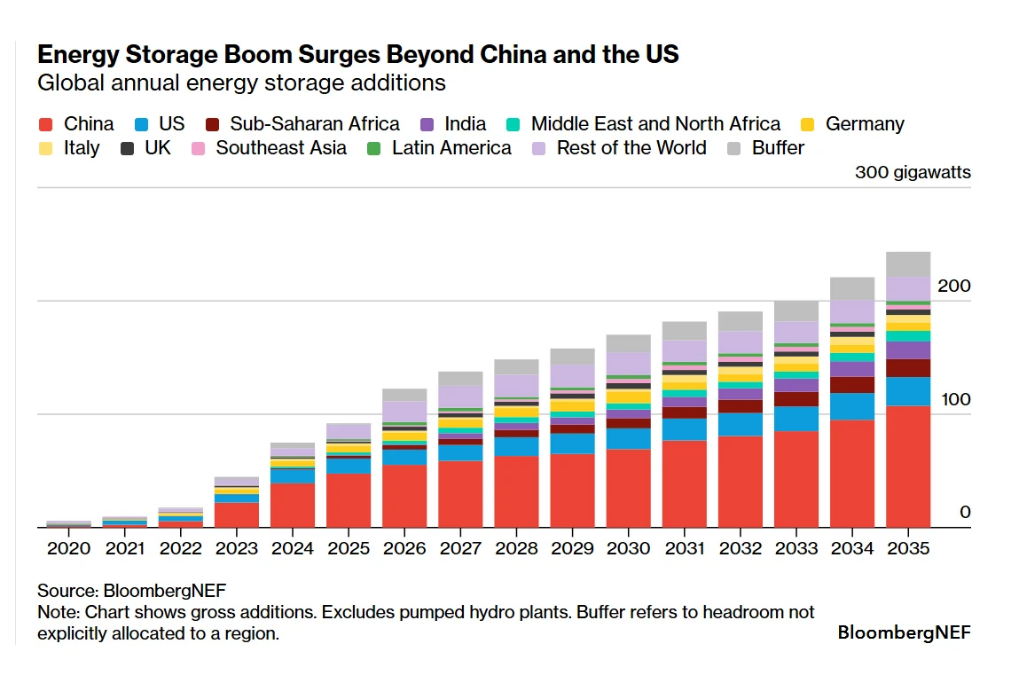
(Source: BloombergNEF Report)
2. BESS in Vietnam
In Vietnam, following the rapid development of renewable energy since 2019, BESS deployment has gradually begun to emerge. However, due to the incomplete policy framework and market mechanisms for BESS, most existing systems are currently installed behind-the-meter at small scales (below 100 kW), primarily in households equipped with rooftop solar systems.
In addition, several larger-scale systems ranging from a few hundred kW to MW-scale capacities have also appeared, although these projects remain limited and are mainly pilot or standalone deployments.
According to the revised Power Development Plan VIII (PDP VIII), Vietnam targets energy storage battery capacity of approximately 10,000–16,300 MW by 2030. This gap of more than 16 GW represents a highly promising growth opportunity for the BESS market in the near future.
The momentum of this market is being strongly driven from two directions:
- From the power sector: Major power corporations are setting ambitious BESS deployment targets as an urgent solution to improve grid flexibility amid the increasing variability of renewable energy and to strengthen backup power capabilities.
- From the private sector: Businesses are also moving aggressively. Many manufacturers and renewable energy investors are rapidly implementing BESS solutions to prepare for the Direct Power Purchase Agreement (DPPA) mechanism, optimize operational costs, improve internal energy security, and capitalize on policies encouraging ancillary services for the power system.
3. Policies and Legal Framework Related to BESS Deployment in Vietnam
Over the past two years, the legal framework for BESS deployment in Vietnam has been significantly improved through several important regulations and standards, including:
- Electricity Law 2024
- TCVN 14499
- TCVN 13252
- Decree No. 58/2025/ND-CP
- Circulars No. 05/2025/TT-BCT, 09/2025/TT-BCT, 12/2025/TT-BCT, 17/2025/TT-BCT, etc
C. Case study at PECC2
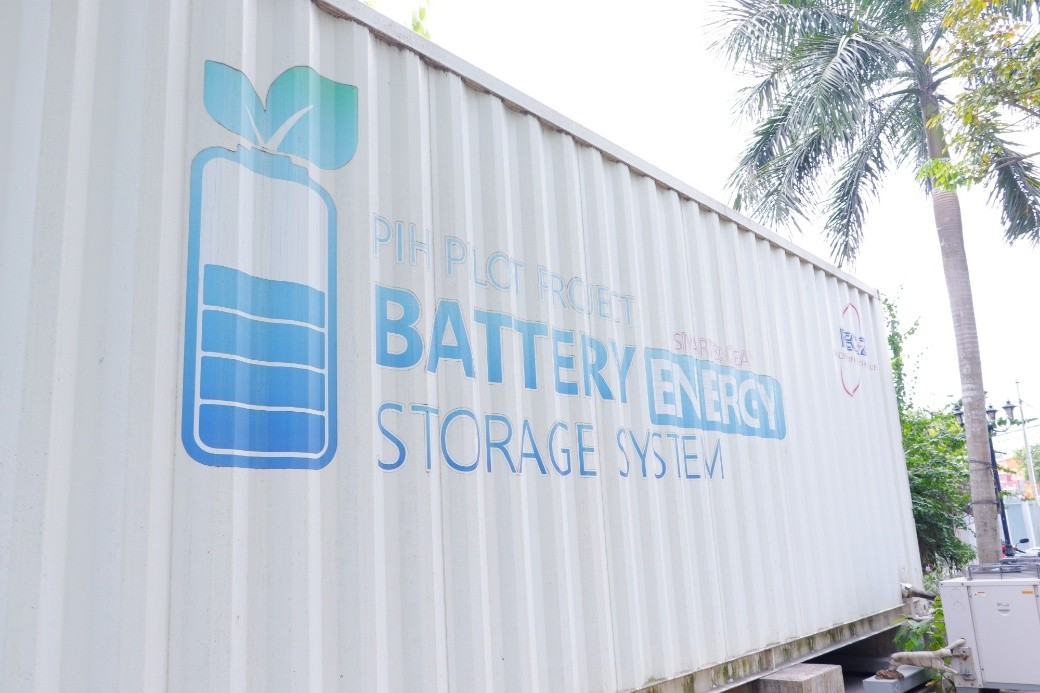
The PECC2 Innovation Hub (PIH) building is one of Vietnam’s pioneering projects applying BESS technology and has been in operation since 2021.
| Item | Specification |
|
Rooftop Sola system |
432 kWp |
| Battery Enerny Storage System | 750kW | 2557 kWh |
| Air Conditioning | VRF Inverter with flexible load-based capacity adjustment |
| Building Envelope | High-performance double-glazed insulated glass to reduce heat radiation |
| Operation Year | Since 2021 |
The BESS system charges during off-peak hours (at night) when electricity prices are low while also storing excess solar energy generated during the daytime (especially on weekends). The stored energy is discharged during peak demand periods to supply the building, reducing dependence on the grid and effectively replacing fossil-fuel-based backup power sources.
According to operational data from 2019–2024, the PIH building achieved approximately 43% electricity cost savings compared to conventional operating methods. The “self-generation – self-consumption” model has operated stably for nearly five years, providing practical evidence of the effectiveness of integrating solar power with BESS in commercial buildings.
PESE’S BESS IMPLEMENTATION CAPABILITIES
Building upon PECC2’s experience and the proven performance of the PIH project, PESE is capable of delivering comprehensive and effective BESS solutions, including:
- Consulting and selecting suitable technologies based on load demand and technical regulations.
- Designing integrated BESS systems combined with solar power, utility grids, and electrical loads.
- Construction and installation in compliance with fire safety standards and technical regulations.
- Operation, maintenance, and optimization of economic performance throughout the project lifecycle.
Choosing PESE is an effective solution to ensure successful BESS project implementation while helping clients maximize both the economic and technical benefits of their energy systems.
By PESE.


Các tin khác
- Head Office Address: PECC2 Innovation Hub, No. 45 Street 2, Thu Duc Ward, Ho Chi Minh City (HCM), Vietnam
- Factory Address: Street 6, Long Khanh Industrial Park, Binh Loc Ward, Dong Nai City
- PESE (Lao) Sole Co., Ltd: Thatluang Tai Village, Saysettha District, Vietiane City, Laos
- Phone: (+84) 789 863 866
- Email: bdd.pese@pecc2.com


All rights reserved


