


PESE COMPLETES FABRICATION OF OVER 70 TONS OF BERTHING STRUCTURE
PESE COMPLETES FABRICATION OF OVER 70 TONS OF BERTHING STRUCTURE STEEL FOR TAN THUAN WIND POWER PLANT – PHASE 3
The Tan Thuan Wind Power Project Phases 1 and 2 (with a total capacity of 75 MW, comprising 18 turbines rated at 4.15 MW each) has been operating stably since 2022, making a significant contribution to clean energy generation and national energy security.
Building on these achievements, in early March 2026, the Tan Thuan Wind Power Project Phase 3 (25 MW) officially commenced pile-driving activities, marking an important milestone in the construction process and paving the way toward the project’s commercial operation date (COD) in the near future.
Amid an accelerated project schedule, PESE’s team of engineers and highly skilled mechanical workers has once again demonstrated outstanding capabilities in the heavy steel structure fabrication segment. We successfully completed the fabrication of more than 70 tons of steel structures for the berthing structure and vessel impact protection system, directly serving the Tan Thuan Wind Power Project (Phase 3) in Cà Mau Province.
This is one of the project’s core marine infrastructure components, ensuring safe vessel berthing and facilitating the transportation of materials and equipment required for construction and installation activities. In addition, this structure provides essential support for long-term operation and maintenance (O&M) throughout the plant’s lifecycle, contributing to stable and efficient project performance over the long term.
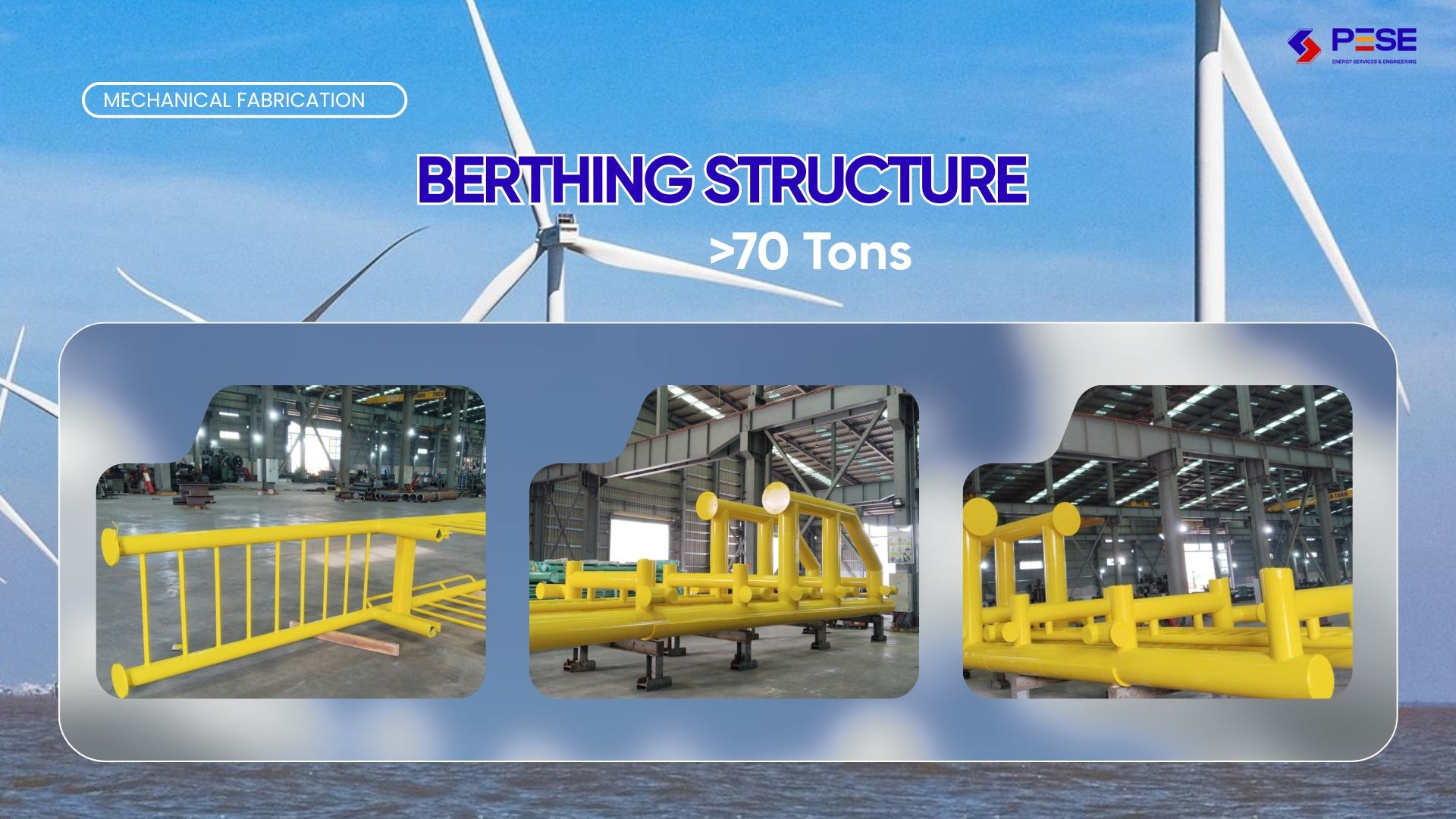
Overcoming the Harsh Marine Environment of Gành Hào
The marine environment in Gành Hào, Cà Mau presents significant challenges for structural materials used in offshore and nearshore infrastructure. High humidity combined with elevated salt concentration can cause conventional steel structures to rust and corrode rapidly.
Therefore, technical standards related to input material quality, welding integrity, and specialized coating systems for this project were maintained at the highest level to ensure maximum safety during access to wind turbine structures throughout both construction and operational.
Optimal Engineering Solutions from Experts with 40 Years of Experience
To effectively address corrosion challenges in marine environments, PESE—leveraging over 40 years of inherited and continuously developed expertise from PECC2—implemented strict quality control procedures beginning with the selection of industrial-grade steel materials capable of withstanding extremely high structural loads.
The entire berthing structure system underwent rigorous surface preparation and was coated with specialized anti-corrosion paint systems designed for harsh marine operating conditions. This solution not only improves resistance against seawater, humidity, ocean currents, and other corrosive factors, but also extends the service life of the structure for decades, enabling investors to optimize lifecycle costs and long-term investment efficiency.
Ready for the Offshore Wind Development Wave
Under Vietnam’s Power Development Plan VIII, the country aims to achieve 6 GW of offshore wind capacity by 2030. PESE’s successful design and fabrication capabilities for steel structures in current nearshore wind power projects serve as a strategic stepping stone, enabling the company to further strengthen its manufacturing and mechanical engineering capabilities for future offshore developments.
Every completed renewable energy project marks a meaningful milestone in PESE’s journey alongside its partners to progressively build a greener and more sustainable future for society.
By PESE


Các tin khác
- Head Office Address: PECC2 Innovation Hub, No. 45 Street 2, Thu Duc Ward, Ho Chi Minh City (HCM), Vietnam
- Factory Address: Street 6, Long Khanh Industrial Park, Binh Loc Ward, Dong Nai City
- PESE (Lao) Sole Co., Ltd: Thatluang Tai Village, Saysettha District, Vietiane City, Laos
- Phone: (+84) 789 863 866
- Email: bdd.pese@pecc2.com


All rights reserved


